
|
|
How
Much
is
My
Book
Worth?
|
|
|
|
||
| Book
dealers are
frequently asked "How much is my old book worth?" With a little research utilizing links to rare-book websites, you can get a good idea of your old book's value. The information below can point you in the right direction ... What factors contribute to the value of a collectible book? Two things ... #1 is Desire and #2 is Condition. Lets start with Desire, or in other words, does anyone want it? If the book is written by a collectible author, "desire" is limited to first or very early printings of their collectible works, or books authentically signed by the collectible author or someone notable. A badly written novel by an uncollected author, no matter how old, no matter how rare has little value if no one wants it (age or scarcity without desire and condition have little effect on a book's value). The second factor effecting value is Condition. Just as "location, location, location" is the mantra in the real estate world, condition makes or breaks the value of a collectible book. Look at your book as a book collector would. A book collector scrutinizes a 100 year antique book for the same flaws as a brand new book. Book collectors and professional book sellers prefer to use one of five categories regarding book condition: Poor, Fair, Good, Very Good, or Fine. Poor: Book is in sad condition. Pages, maps, or boards may be missing or torn. Book may be badly soiled or scribbled on by a child. Fair: Loose pages, soiled, loose spine, etc. The book is complete, all pages & maps present. Good: A book that is clean inside, complete and all pages present and attached. Nothing torn. Spine is fairly strong. Very Good: A strong, clean book, some shelf wear, perhaps only a neatly written previous owner signature inside. Fine: An attractive book. Bright pages, no writing, no bumps or wear. It looks new. More Information...
|
|||||
|
Links
to
Books
About
Books Available
Through
Amazon.com. If
you buy, collect or sell books, these should be your first
investment...
First Editions: A Guide to Identification  Edward N Zempel
(Editor).
Hardcover 4th Edition (November 2001). A compilation of publishers
actual statements
about their methods of identifying first editions. Covers nearly 1700
trade
and academic publishers in the US, the UK, Ireland, Canada, Australia
and
New Zealand. For all bibliophiles. Edward N Zempel
(Editor).
Hardcover 4th Edition (November 2001). A compilation of publishers
actual statements
about their methods of identifying first editions. Covers nearly 1700
trade
and academic publishers in the US, the UK, Ireland, Canada, Australia
and
New Zealand. For all bibliophiles.Antique Trader Book Collector's Price Guide Richard Russell. Paperback 2009. Organized in 13 categories, including Americana, banned, paranormal and mystery, this guide discusses identifying and grading books, and provides collectors with details for identifying and assessing books in 8,000 listings. The Official Price Guide to Collecting Books, 6th Edition  Marie
Tedford. Paperback
2008.
Although
used
book
prices
fluctuate,
sometimes
its
good
to
have
a book you can refer to when the computer's not turned on :) " ... This guide prices everything
from
rare
signed
first
editions
of The
Wizard of Oz to today's Harry Potter
blockbusters. Contains information on popular genres, care and repair,
research resources, Internet sites, dealers, and auction houses ... "
Marie
Tedford. Paperback
2008.
Although
used
book
prices
fluctuate,
sometimes
its
good
to
have
a book you can refer to when the computer's not turned on :) " ... This guide prices everything
from
rare
signed
first
editions
of The
Wizard of Oz to today's Harry Potter
blockbusters. Contains information on popular genres, care and repair,
research resources, Internet sites, dealers, and auction houses ... "Pocket Guide to the Identification of First Editions  Bill McBride. Paperback 2000
Very useful book.
Publishers each have
their own way of identifying the first edition (or more correctly -
first printing
) of any book they produce. This little book lists most publishers and
uses a simplified code system based on the author's experience
handling actual first editions. Bill McBride. Paperback 2000
Very useful book.
Publishers each have
their own way of identifying the first edition (or more correctly -
first printing
) of any book they produce. This little book lists most publishers and
uses a simplified code system based on the author's experience
handling actual first editions.
Points
of
Issue:
A
Compendium
of
Points
of
Issue
of
Books
by
19Th-20th
Century
Authors  Ian
C. Ellis.
Paperback 2006. A good first hand account of book buying and book
scouting. The author drops a lot of names, but the book is an enjoyable
read. "The used and collectible book market divides into three
relatively
neat categories: reading copy, antiquarian, and modern first edition..."
Ian
C. Ellis.
Paperback 2006. A good first hand account of book buying and book
scouting. The author drops a lot of names, but the book is an enjoyable
read. "The used and collectible book market divides into three
relatively
neat categories: reading copy, antiquarian, and modern first edition..."The Home-Based Bookstore: Start Your Own Business Selling Used Books on Amazon, eBay or Your Own Web Site  Steve Weber.
Paperback 2005.
A super book, one of the best rated books by Amazon readers regarding selling books on-line. A "must
have".
" ... Selling used books on the Internet is one of the greatest
opportunities available to small entrepreneurs today ..." Steve Weber.
Paperback 2005.
A super book, one of the best rated books by Amazon readers regarding selling books on-line. A "must
have".
" ... Selling used books on the Internet is one of the greatest
opportunities available to small entrepreneurs today ..."
An annotated Copyright Page from an actual First Printing of the First Edition of "Harry Potter and the Deathly Hallows". Feel free to link directly to this image from your website. 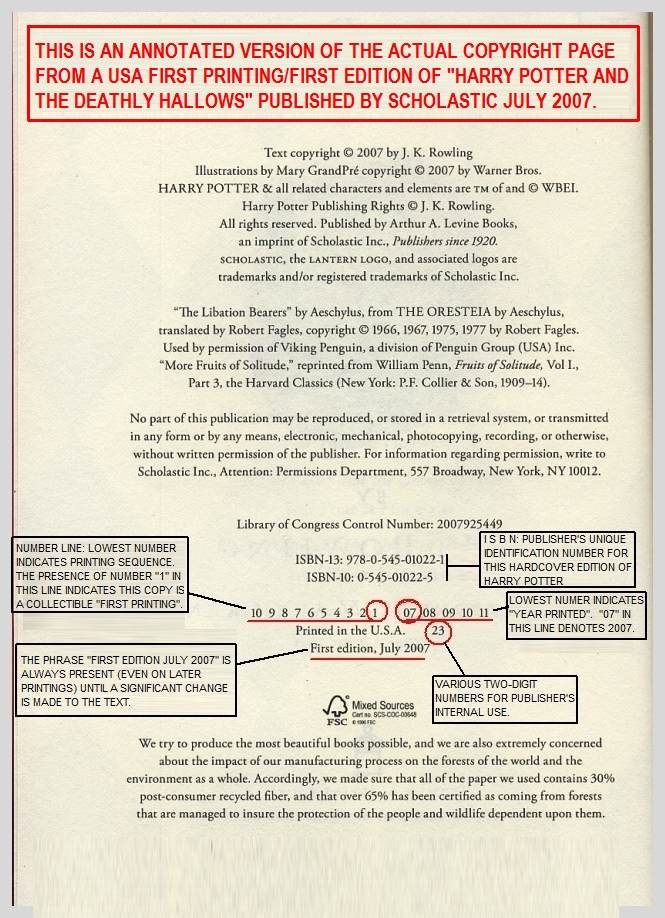 |
|||||
 |
|
|
 Bill McBride.
Paperback 1996. Another pocket-sized
companion
to the Guide listed above, it's also very useful. This is a list of
specific
books which have details (points of issue) that determine a first
edition.
Bill McBride.
Paperback 1996. Another pocket-sized
companion
to the Guide listed above, it's also very useful. This is a list of
specific
books which have details (points of issue) that determine a first
edition.